Kids And The Open Web
Every time I think about why I like the open web, I basically think of how well it fits with the way I learned to use and program computers as a kid: my first computer, an Atari 400, came with everything I needed to do programming, and I (or my parents) didn’t have to spend hundreds of dollars or sign an NDA to get a development tool.
My favorite technical book as a child was Creating Adventure Games On Your Computer, which contained plain BASIC code for games that you could play, augment, and make your own. A column in one of my favorite magazines, 3-2-1 Contact, featured the same kind of content.
All of this was easy enough for a child to grasp—often far easier, as Jef Raskin observed in The Humane Interface, than today’s development tools. But being able to use a tool that provided an incredibly low barrier to generativity is something that I value a lot about my childhood. It’s in part where a lot of the real passion and excitement for open source and the Open Web come from: people like me see in them the qualities that made them truly excited about computers as a kid. Qualities that we’re constantly in danger of losing today as the field becomes more professionalized and controlled.
So that got me thinking about Drumbeat again: what if promotional materials for the Open Web focused on how it makes lives better for children who are budding hackers? Lots of adults aren’t tech savvy, but they know that their kids are, and if we can prove that the Open Web is better for their kids, and that they can make their kids’ lives better by choosing a standards-compliant browser, maybe they will.
After playing around with this idea for a bit, I came up with this:
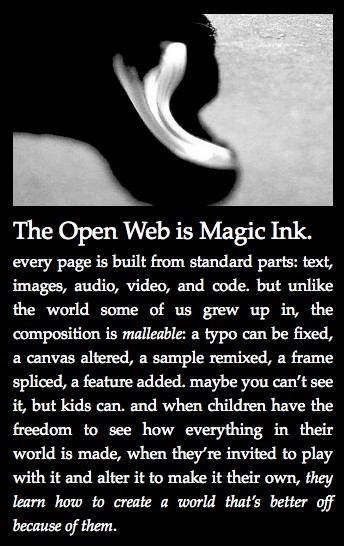
The photo on the page is taken from Flickr user .sick sad little world.’s The Taste of Ink. Feel free to get the source and remix!


September 4th, 2009 at 8:59 am
Atul,
it’s a pleasure to read your posts. They’re really good food for thought. Keep them coming!
I like this part: “they learn how to create a world that’s better off because of them”. However, I don’t think it’s directly related to using a standards-compliant browser (which could run a Flash applet), while it’s related to using Open Web technologies, precisely thanks to view-source & co, which enable generativity. I’m just nitpicking here, keep up the good work!
September 4th, 2009 at 9:44 am
But as far as I know there is no material targeted at kids on Mozilla.
That would be great to have something for people who want to learn programming. Mozilla and the Web in general seems to be the ideal platform for that, with tools such as Jetpack there is no doubt possible. What is missing is an introduction to the Open Web and the way to hack into it.
It requires to explain HTML and the DOM, styling and JavaScript, it’s not so easy when you think about it…
September 4th, 2009 at 10:33 am
Yeah, this is totally right.
September 4th, 2009 at 12:12 pm
Love it!
That’s a great message to send. And an important one.
September 4th, 2009 at 2:28 pm
[...] 4, 2009 Atul Varma of Mozilla Labs has a great post up, “Kids and the Open Web” where he advocates having the Mozilla Drumbeat initiative explicitly include some messaging [...]
September 5th, 2009 at 8:34 am
If you really want to target kids, you’ll have to internationalize the documentation/reference, the MDC I mean. Because not all kids know english. And more explaination as well.
September 5th, 2009 at 10:30 am
Thanks for the responses so far!
@Tristan: Thanks, I’ll keep them coming
I agree with the nitpick, though it seems hard to convey this subtlety to non-technical people. It’s even harder when you realize that the tools to create content on the closed platforms–e.g., Adobe’s entire suite–tend to be so much nicer than the Open Web’s, which might have something to do with the web’s origins in academia and hacker culture (rather than a company making a content creation tool for non-techies). I guess this is part of why I’m so excited about the work the developer tools lab is doing, e.g. with Bespin.
I also think these ideas go beyond “view source” to “change source”, or something more akin to the kinds of dynamic inspection and manipulation capabilities that Firebug offers. “view source” is a tool for web 1.0, the world of static content, but these days viewing the original source of a page might actually tell you very little about the page you’re looking at.
@lrbabe: I agree. I tried exploring this education space a bit with my Open Web Challenges earlier this year, but I need to write more of those. Also, Frank Hecker just posted a follow-up to this post that focuses on this issue too.
September 5th, 2009 at 1:38 pm
hi Atul,
I think you nailed it by bringing up video games. Many people myself included became fascinated with computers mostly at first due to spending inordinate amount of time playing video games. For me personally I always felt drawn to computers by a combination of mechanical wonder(they seemed magical to me when I was 6) and the fact that I was in control when playing video games or using a computer. The characters in the game or the computer followed my every command, this was empowering as a kid who has almost no control over his life with adults always telling you what to do, and where to be.
It would be great if Mozilla got more involved in developing software development teaching programs. Using games as the tool to motivate kids would work very well. Would be cool if Mozilla developed a series of simple but fun web based games, and then a series of tutorials explaining programming concepts that hacked on these games by example.
This was something that I wanted to approach Mozilla about myself. Earlier this year I had attempted to get involved in Mozilla Labs. Started doing a pilot project with Ben/Dion on the side of my current work. But my situation changed with a core member of my project leaving and I had to drop the Mozilla work to pick up the slack.
My work load has been lessening up lately, which is making me get more interested in getting involved again. Will keep you posted as I put up a site related to this.
Great posts lately. More conversation of this nature needs to be taking place,
Francois
September 15th, 2009 at 6:10 pm
[...] Here’s one: the open web is a world where kids can teach themselves how to hack. [...]
October 2nd, 2009 at 4:25 am
[...] Varma recently posted about the open web as ‘magic ink’ — a set of technologies that lets us shape and transform the digital world around us. While [...]
October 23rd, 2009 at 10:55 am
[...] have been bunch of Mozilla people asking the question ‘what is the open web?‘ of late. Atul, Jono and Mitchell all blogged about it a few weeks back. People at MozaCamp Europe drew pictures [...]
November 10th, 2009 at 11:41 am
[...] an interactive shell for tinkering with the browser, since it bundles Bespin; a playground for budding coders, potentially; portable to other XULRunner apps like Thunderbird; and a mechanism for extending not [...]
November 15th, 2009 at 5:31 am
But as far as I know there is no material targeted at kids on Mozilla.
That would be great to have something for people who want to learn programming. Mozilla and the Web in general seems to be the ideal platform for that, with tools such as Jetpack there is no doubt possible. What is missing is an introduction to the Open Web and the way to hack into it.
May 30th, 2010 at 8:05 am
[...] Read the whole piece here. [...]
May 30th, 2010 at 12:17 pm
[...] Megan Finn’s section on “Techne-Mentoring”. As I’ve explained in my post on Kids and The Open Web, when I was wee, learning about computers was very much about creating and hacking on things that I [...]
June 1st, 2010 at 11:46 am
[...] what is the open web? contest from earlier this year and by other attempts to define the open [...]
October 3rd, 2010 at 4:34 pm
[...] Mozilla, we often talk about how hackable and remixable the Web is, and I wrote about it once myself. But to most people, it’s not obvious: the Web seems just as immutable and opaque as any [...]
November 29th, 2010 at 2:01 am
[...] by Atul Varma’s Magic Ink blog post and his htmlpad slides, I’ve hacked-up a first cut. It uses Janne Aukia’s [...]
November 29th, 2010 at 1:11 pm
Anna Debenham mentioned in her keynote talk (http://vimeo.com/16908771) at the Drumbeat Festival that she first learned HTML on the NeoPets site (http://www.neopets.com/help/html1.phtml). That guide is a bit outdated now, but it provides an interesting example of how to teach web technologies to kids. First, it’s written at a grade-school comprehension level. Second, it’s in a context where kids are motivated to learn in order to be able to do something (create a page about a toy); it’s not just in an abstract setting. Third, it has a low barrier to entry because the kids can use the NeoPets site as their server, and see their code running live immediately. Those would all be good things to keep in mind when considering creating learning resources for kids.
December 27th, 2011 at 10:59 am
[...] working on Hackasaurus? Atul – For me personally, it was something I was excited about and blogged about in 2009. Mark Surman (Mozilla Foundation Executive Director) really liked the post and later invited [...]
February 20th, 2012 at 10:27 am
[...] Kids and the open web. (Atul) [...]